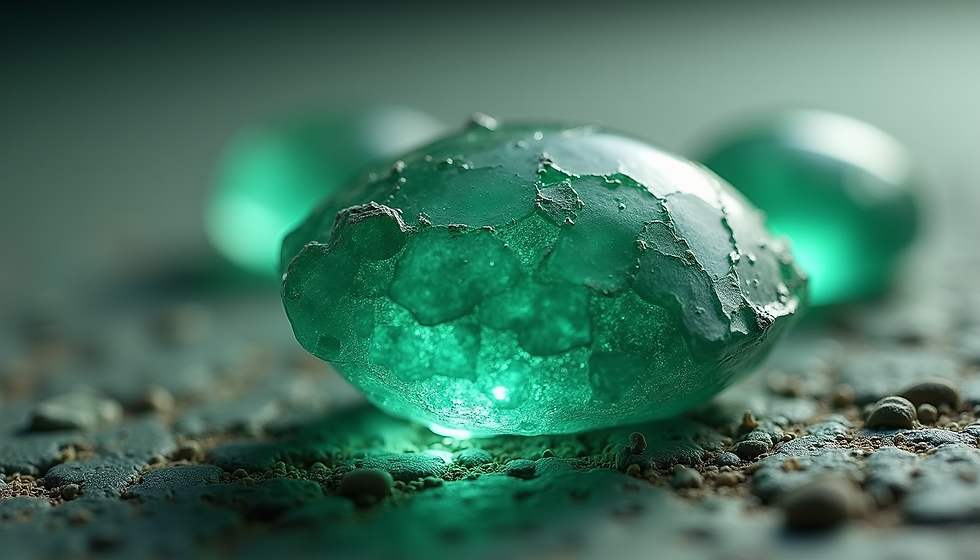
Why Every Gemstone Is Unique

Updated: Apr 16
Gemstones have fascinated humanity for centuries. Their beauty, rarity, and the stories they carry make them highly sought after. But what truly sets each gemstone apart? Why is every gemstone unique, especially among the affordable, semi-precious varieties? This post explores the natural creation of gemstones, the role of inclusions and mineral compositions, and the reasons behind their individuality. If you are curious about gemstones or looking to add unique pieces to your collection, keep reading. You can also explore a wide variety of gemstones at Lireza, our online store at lireza.co.za, where affordability meets quality.

How Are Gemstones Created Naturally
Gemstones form deep within the Earth over millions of years through geological processes involving heat, pressure, and mineral-rich fluids. Most semi-precious gemstones originate from igneous, metamorphic, or sedimentary rocks.
Igneous formation occurs when molten rock cools and crystallises. For example, amethyst, a variety of quartz, forms in volcanic rocks as silica-rich fluids cool slowly.
Metamorphic formation happens when existing rocks undergo transformation due to intense heat and pressure without melting. Garnet is a common semi-precious gemstone created this way.
Sedimentary formation involves minerals precipitating from water or accumulating in layers. Malachite, with its vibrant green bands, often forms in this environment.
The exact conditions—temperature, pressure, chemical environment—vary widely, influencing the size, shape, and colour of the resulting gemstones. This natural variability ensures no two gemstones are exactly alike.
What Are Inclusions and Mineral Compositions
Inclusions are tiny imperfections or foreign materials trapped inside a gemstone during its formation. These can be minerals, gas bubbles, liquids, or even microscopic crystals. While inclusions might sound like flaws, they actually contribute to a gemstone’s character and uniqueness.
Types of inclusions include needles, feathers, crystals, and clouds.
Mineral composition refers to the specific elements and compounds that make up the gemstone. For example, quartz is primarily silicon dioxide, but trace elements like iron or manganese can change its colour.
The combination of inclusions and mineral composition affects a gemstone’s clarity, colour, and overall appearance.
In semi-precious stones like citrine, peridot, or smoky quartz, inclusions are common and often add to their charm. Collectors and enthusiasts appreciate these natural fingerprints because they tell the story of the gemstone’s journey through the Earth.
Why Is Every Gemstone Unique
Several factors combine to make each gemstone one of a kind:
Natural formation conditions differ even within the same location. Slight changes in temperature, pressure, or chemical environment create variations in colour, size, and clarity.
Inclusions and internal features vary widely. No two gemstones have the exact same pattern or type of inclusions.
Trace elements influence colour hues. For example, the presence of chromium gives zoisite its green color, while iron can create the yellow of citrine.
Because of these factors, even gemstones from the same location and species can look very different.
The table below reflects a sample set of gemstones and looks at their formation within earth's natural environments, their mineral composition, what makes it unique, the gemstones Mohs hardness and the gemstones natural colour range. This serves to further the understanding of why every gemstone is unique by looking at a high level of the gemstone classification.
Gemstone | Formation | Mineral Composition | What Makes It Unique | Mohs Hardness | Colour Range |
Lava Stone | Rapid cooling of molten lava | Basalt (silicates: pyroxene, olivine) | Porous, lightweight | 3–4 | Black, dark grey |
Amethyst | Hydrothermal veins in volcanic rock | Quartz + iron impurities | Purple crystal clarity | 7 | Light to deep purple |
Rose Quartz | Pegmatites | Quartz + titanium/iron | Soft pink translucence | 7 | Pale to deep pink |
Clear Quartz | Igneous & metamorphic | Pure SiO₂ | High clarity, versatile | 7 | Transparent |
Citrine | Heat-altered quartz | Quartz + iron | Golden/yellow tones | 7 | Yellow to orange |
Carnelian | Silica-rich sedimentary | Chalcedony + iron oxide | Warm orange glow | 6.5–7 | Orange, reddish |
Onyx | Layered chalcedony formation | Quartz with carbon/iron | Parallel bands | 6.5–7 | Black, white |
Tiger’s Eye | Altered crocidolite fibres | Quartz + iron | Chatoyancy (silky shine) | 6.5–7 | Gold, brown |
Hematite | Sedimentary/oxidation | Iron oxide (Fe₂O₃) | Metallic sheen | 5–6 | Silver, black, red |
Obsidian | Rapid lava cooling (glass) | Volcanic glass (SiO₂-rich) | Glassy, sharp edges | 5–5.5 | Black, brown |
Turquoise | Secondary mineral in arid regions | Copper aluminium phosphate | Sky-blue colour | 5–6 | Blue, green |
Lapis Lazuli | Metamorphic limestone | Lazurite + calcite + pyrite | Deep blue with gold flecks | 5–5.5 | Blue with gold |
Malachite | Copper oxidation zones | Copper carbonate hydroxide | Swirling green bands | 3.5–4 | Green |
Amazonite | Igneous pegmatites | Microcline feldspar + lead | Blue-green hue | 6–6.5 | Blue-green |
Aventurine | Quartzite | Quartz + mica/fuchsite | Sparkly inclusions | 6.5–7 | Green, orange |
Moonstone | Igneous (feldspar) | Orthoclase feldspar | Adularescence glow | 6–6.5 | White, blue sheen |
Sunstone | Igneous feldspar | Feldspar + hematite | Glittering aventurescence | 6–6.5 | Orange, gold |
Sodalite | Igneous rock | Sodium aluminium silicate | Deep royal blue | 5.5–6 | Blue, white |
Fluorite | Hydrothermal veins | Calcium fluoride (CaF₂) | Fluorescence | 4 | Purple, green |
Howlite | Evaporite deposits | Calcium borosilicate | White with grey veining | 3–3.5 | White, dyed colours |
Unakite | Metamorphic granite | Feldspar + epidote + quartz | Green-pink mix | 6–7 | Green, pink |
Bloodstone | Chalcedony | Quartz + iron oxide | Red specks in green | 6.5–7 | Green, red |
Chrysocolla | Copper deposits | Hydrated copper silicate | Blue-green softness | 2–4 | Blue, green |
Serpentine | Metamorphic | Magnesium silicate | Waxy texture | 3–5 | Green |
Peridot | Igneous mantle-derived | Olivine ((Mg,Fe)₂SiO₄) | Bright lime green | 6.5–7 | Green |
Garnet | Metamorphic | Silicate group (Fe, Mg, Ca) | Deep saturation | 6.5–7.5 | Red, green, orange |
Spinel | Igneous/metamorphic | MgAl₂O₄ | High brilliance | 7.5–8 | Red, blue, black |
Zoisite (Ruby in Zoisite) | Metamorphic | Zoisite + corundum | Mixed green & ruby | 6–7 | Green, red |
Kyanite | Metamorphic | Aluminium silicate | Variable hardness | 4.5–7 | Blue |
Labradorite | Igneous feldspar | Plagioclase feldspar | Iridescent flashes | 6–6.5 | Grey, blue, rainbow |
Rhodonite | Metamorphic | Manganese silicate | Pink with black veins | 5.5–6.5 | Pink, black |
Charoite | Metasomatic | Potassium calcium silicate | Swirling purple patterns | 5–6 | Purple |
Prehnite | Hydrothermal | Calcium aluminium silicate | Soft translucent glow | 6–6.5 | Pale green |
Dalmatian Stone | Igneous | Feldspar + black tourmaline | Spotted pattern | 5.5–7 | Beige, black spots |
If you want to experience this variety firsthand, visit Lireza, our online store at lireza.co.za. We offer a diverse selection of gemstones, each unique in its appearance and composition as nature intended.
Final Tips for Choosing Your Unique Gemstones
Look for natural inclusions as signs of authenticity and individuality.
Choose stones with colours and cuts that appeal to you personally rather than just market trends.
Buy from trusted sources like Lireza at lireza.co.za to ensure quality and variety.
Handle gemstones carefully to preserve their natural beauty.
Every gemstone you choose carries a piece of Earth’s history and a unique fingerprint that no other stone can replicate. Embrace this uniqueness when selecting your next gemstone, and enjoy the natural wonder it brings to your collection or jewellery.